
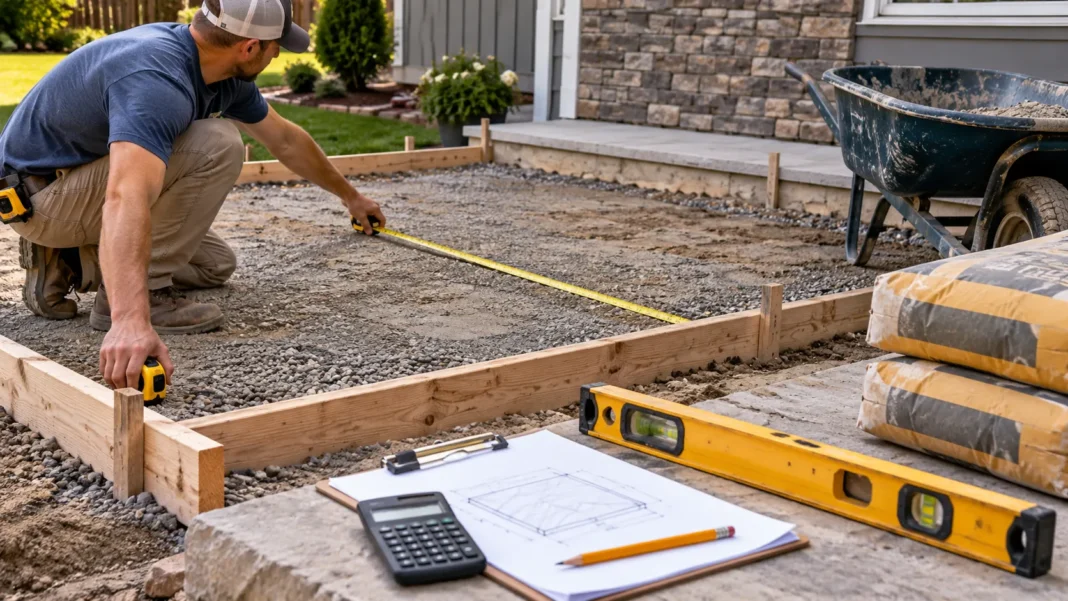

Knowing how much concrete you need is one of the most important steps when planning a construction or home improvement project. Whether you are building a patio, driveway, walkway, concrete slab, or fence post foundation, estimating the correct amount helps you manage materials and avoid unnecessary expenses. Ordering too little concrete can interrupt a project, while ordering too much can increase costs and waste.
Concrete quantity is usually calculated using the length, width, and depth of the space being filled. Depending on your location, concrete may be measured in cubic feet, cubic yards, or cubic meters. The calculation is relatively straightforward for rectangular areas, but irregular shapes, foundations, and multiple sections can require additional planning.
This guide explains how to calculate concrete volume, convert measurements, estimate concrete bags, and determine the amount required for common projects. It also includes practical examples, calculation formulas, and tips for preventing measurement mistakes. Whether you are preparing a small home project or estimating materials for a larger construction job, understanding concrete quantity calculations will help you plan more accurately.
How Much Concrete Do I Need?
The amount of concrete you need depends on the size, shape, and thickness of the area being filled. For a basic rectangular slab, multiply its length by its width and depth, ensuring that all measurements use the same units. The result gives the required concrete volume. This measurement is the starting point for estimating material quantities.
For example, a concrete slab measuring 10 feet long, 10 feet wide, and 4 inches thick requires approximately 33.33 cubic feet of concrete. Since one cubic yard contains 27 cubic feet, this equals about 1.23 cubic yards before adding any allowance. This example demonstrates why slab thickness is important. Even a small change in depth can affect the total amount.
Most concrete projects also require some allowance for minor measurement differences, uneven ground, and material loss. A commonly used planning allowance is around 5% to 10%, although actual requirements vary. Complex projects may need more careful evaluation. Accurate measurements and a realistic allowance help reduce ordering problems.
Understanding Concrete Measurements and Units
Concrete is measured by volume rather than surface area because it fills a three-dimensional space. Length and width describe the area being covered, while thickness or depth determines how much material is required. Ignoring any of these dimensions produces an incorrect estimate. Understanding volume units is essential for reliable calculations.
In the United States, ready-mix concrete is commonly ordered in cubic yards. Smaller packaged quantities may be described by cubic-foot yield. Countries using the metric system generally measure concrete in cubic meters. Converting between these units makes it easier to compare different suppliers and project specifications.
| Measurement | Equivalent |
|---|---|
| 1 cubic yard | 27 cubic feet |
| 1 cubic foot | 1,728 cubic inches |
| 1 cubic yard | Approximately 0.765 cubic meters |
| 1 cubic meter | Approximately 35.315 cubic feet |
| 1 cubic meter | Approximately 1.308 cubic yards |
Using consistent units throughout the calculation is particularly important. A common mistake is multiplying dimensions measured in feet and inches without converting them first. A clear measurement system makes the process easier. Recording all dimensions before calculating helps prevent confusion.
Concrete Calculation Formula
The basic concrete volume formula is length multiplied by width multiplied by depth. This works for rectangular slabs, foundations, and other regularly shaped spaces. All three measurements must use the same unit. The calculated volume can then be converted into the units required by the concrete supplier.
For measurements in feet, the formula is:
Concrete volume (cubic feet) = Length (ft) × Width (ft) × Depth (ft)
To convert the result into cubic yards, divide the cubic-foot volume by 27. If slab thickness is measured in inches, divide it by 12 to convert it into feet. Combining these steps creates a convenient formula for typical construction measurements.
Concrete volume (cubic yards) = Length (ft) × Width (ft) × Thickness (in) ÷ 324
For metric measurements, multiply length, width, and thickness in meters. The resulting volume is expressed in cubic meters. These formulas calculate the geometric volume, so any appropriate ordering allowance should be considered separately.
1. How to Calculate Concrete for a Slab
Concrete slabs are commonly used for patios, garages, garden structures, and other flat surfaces. Calculating slab volume begins by measuring the intended length, width, and thickness. These measurements determine the total space the concrete will occupy. Accurate dimensions are especially important when a slab covers a large area.
Suppose a rectangular slab measures 12 feet long, 10 feet wide, and 4 inches thick. The calculation becomes 12 × 10 × 4 ÷ 324, giving approximately 1.48 cubic yards. This represents the theoretical volume before accounting for minor variations. The calculation can be repeated for slabs of other dimensions.
The required slab thickness depends on the intended use, ground conditions, and applicable construction requirements. A pedestrian surface may have different specifications from a garage floor or structural foundation. Thickness should not be chosen solely to reduce material costs. Consult suitable project specifications or a qualified professional when structural requirements are involved.
2. How Much Concrete for a 10×10 Slab?
A 10×10 concrete slab is a common example used when estimating small outdoor surfaces. Its total area is 100 square feet. However, the amount of concrete depends on the specified thickness. A thicker slab requires more material even though the surface dimensions remain unchanged.
For a slab measuring 10 feet by 10 feet and 4 inches thick, multiply 10 × 10 × 4 and divide by 324. The result is approximately 1.23 cubic yards. If the slab were 6 inches thick, the required volume would increase to approximately 1.85 cubic yards. These figures exclude waste allowances.
Before placing an order, confirm the actual prepared dimensions. Excavation depth and formwork dimensions should match the required design. An uneven base can increase concrete consumption beyond the theoretical calculation. Measuring the prepared area helps improve the estimate.
3. How Much Concrete for a 12×12 Slab?
A 12×12 concrete slab covers 144 square feet and may be used for a patio, garden feature, or other suitable surface. To calculate its concrete volume, identify the required thickness. The same rectangular slab formula applies. Keeping measurements consistent ensures the result is expressed correctly.
At 4 inches thick, the calculation is 12 × 12 × 4 ÷ 324, giving approximately 1.78 cubic yards. Increasing the thickness to 6 inches raises the requirement to approximately 2.67 cubic yards. This difference demonstrates how thickness affects the quantity. The values represent geometric estimates without additional allowances.
For projects using ready-mix concrete, the calculated amount can help when requesting supplier quotes. Bagged concrete may be practical for smaller projects, but larger quantities can become difficult to manage. Supplier delivery minimums and project requirements should also be considered. Comparing total costs helps determine the appropriate option.
4. How Much Concrete for a 20×20 Slab?
A 20×20 slab has a surface area of 400 square feet. Projects of this size may include substantial patios, garage floors, or other large paved surfaces. Estimating concrete requirements accurately becomes increasingly important as the surface area grows. Small depth differences can create noticeable changes in total volume.
For a 4-inch-thick slab, multiply 20 × 20 × 4 and divide by 324. The result is approximately 4.94 cubic yards. A 6-inch-thick version requires approximately 7.41 cubic yards. These figures provide useful planning estimates before any additional allowance is included.
Larger concrete projects require careful preparation because the material has limited working time after mixing. The actual construction process should be planned according to the project specifications and site conditions. Professional installation may be appropriate for large or load-bearing surfaces. An accurate volume estimate is only one part of successful project planning.
5. How to Calculate Concrete for a Driveway
Concrete driveways require volume calculations based on the surface dimensions and specified depth. For a rectangular driveway, the standard length-times-width-times-thickness formula applies. Driveways with curves or wider sections may need to be divided into smaller shapes. The individual volumes can then be added together.
Consider a driveway measuring 20 feet long, 12 feet wide, and 6 inches thick. The calculation is 20 × 12 × 6 ÷ 324, producing approximately 4.44 cubic yards. This figure excludes any appropriate additional allowance. Different driveway dimensions or thickness requirements will change the result.
Driveway design must account for vehicle loads, soil conditions, reinforcement requirements, and local standards. The thickness should be determined by the intended use and applicable design guidance. An accurate quantity calculation cannot replace structural planning. For demanding applications, qualified professional advice is important.
6. How to Calculate Concrete for a Patio
Patios are common outdoor concrete projects, and their size can vary considerably. Most rectangular patios are relatively easy to estimate using basic volume calculations. Measure the finished length and width, then determine the required thickness from the project design. The result provides the theoretical volume of concrete.
For example, a patio measuring 15 feet by 12 feet with a 4-inch thickness requires approximately 2.22 cubic yards. This is calculated using 15 × 12 × 4 ÷ 324. If the patio has an irregular outline, calculate separate rectangular or other geometric sections. Adding those volumes provides a closer estimate.
Patios may also include thicker edges or other features that require additional material. These sections should be measured separately rather than ignored. Surface grading and prepared base conditions can affect the quantity required. A complete measurement plan helps reduce the chance of ordering too little concrete.
7. How to Calculate Concrete for a Sidewalk
Sidewalks and garden walkways are often long, narrow concrete surfaces. Their concrete requirements depend on width, length, and the specified thickness. Straight walkways can be calculated as simple rectangular slabs. More complicated paths can be divided into manageable sections.
Suppose a walkway measures 30 feet long, 3 feet wide, and 4 inches thick. The calculation is 30 × 3 × 4 ÷ 324, giving approximately 1.11 cubic yards. Adding separate sections allows the same method to work for longer routes. An additional allowance may be appropriate depending on site conditions.
Walkway projects should also consider drainage, ground preparation, and applicable accessibility or construction requirements. Curves and variable-width areas may require more detailed measurements. Estimating the finished dimensions helps improve quantity accuracy. Proper planning supports both efficient material use and suitable finished performance.
8. How Much Concrete for Fence Posts?
Concrete may be used around fence posts to help support the installed structure. The quantity depends on the dimensions of each hole, the portion occupied by the post, and the relevant installation design. Circular holes require a different volume formula from rectangular slabs. Accurate measurements are important when estimating several posts.
For a cylindrical hole, calculate the hole volume using π multiplied by the radius squared and the depth. If the post occupies part of that space, subtract its displaced volume from the hole volume. This provides a closer estimate than treating the entire hole as empty. The total can then be multiplied by the number of similar holes.
Fence foundation requirements vary with soil conditions, fence height, wind exposure, and local construction rules. Not every fence design uses identical hole dimensions or concrete arrangements. Manufacturer instructions and applicable regulations should guide the installation. The volume calculation should reflect the approved design rather than arbitrary dimensions.
9. How to Calculate Concrete for Footings
Concrete footings distribute structural loads into the supporting ground. Their dimensions depend on the building design, soil conditions, and relevant construction standards. Rectangular footings can be estimated using the standard volume formula. More complicated shapes may need additional calculations.
For example, a rectangular footing measuring 4 feet long, 2 feet wide, and 1 foot deep has a volume of 8 cubic feet. Dividing by 27 gives approximately 0.30 cubic yards. Multiple identical footings can be calculated by multiplying the individual volume by the number required. Different footing sizes should be evaluated separately.
Footings are structural elements, so their design should not be based only on convenient concrete quantities. Insufficient dimensions or unsuitable construction can create serious safety concerns. A qualified engineer or other authorized professional may be required. The calculation provides a material estimate after appropriate footing dimensions have been established.
10. How to Calculate Concrete in Cubic Yards
Cubic yards are commonly used when ordering ready-mix concrete in the United States. One cubic yard equals 27 cubic feet. Calculating in cubic yards allows you to compare estimates directly with supplier quantities. It also makes larger project measurements easier to communicate.
Begin by calculating the volume in cubic feet using consistent measurements. Divide the result by 27 to convert it into cubic yards. Alternatively, when length and width are in feet and thickness is in inches, divide their product by 324. Both methods produce the same result.
For example, a slab measuring 18 feet by 12 feet and 5 inches thick requires approximately 3.33 cubic yards. This is the theoretical volume without an allowance. Suppliers may have minimum delivery requirements or other ordering conditions. Confirming their policies helps avoid unexpected costs.
11. How to Calculate Concrete in Cubic Meters
Cubic meters are commonly used for concrete calculations in countries that follow the metric system. One cubic meter represents a cube measuring one meter in each direction. Calculating concrete in cubic meters is straightforward when all dimensions are recorded in meters. No additional conversion is needed before multiplication.
Suppose a slab measures 5 meters long, 4 meters wide, and 0.10 meters thick. Multiply 5 × 4 × 0.10 to obtain 2 cubic meters. If thickness is initially recorded in millimeters, convert it into meters first. For example, 100 millimeters equals 0.10 meters.
Metric calculations are useful for comparing material estimates with local supplier requirements. However, measurements should be checked carefully before ordering. Mixing centimeters, millimeters, and meters can create substantial errors. Consistent units are essential for accurate concrete estimates.
12. How Many Bags of Concrete Do I Need?
Bagged concrete is commonly used for smaller projects where ordering a ready-mix delivery may not be practical. Bags are sold by weight, but the important measurement for estimating quantities is their finished concrete yield. A heavier bag generally produces more concrete. However, the actual yield depends on the specific product.
Common planning estimates for standard concrete mixes include approximately 0.30 cubic feet from a 40-pound bag, 0.45 cubic feet from a 60-pound bag, and 0.60 cubic feet from an 80-pound bag. These are approximate values, not universal specifications. Always check the yield printed on the package.
| Bag Size | Approximate Concrete Yield | Bags per Cubic Yard |
|---|---|---|
| 40 lb | 0.30 cubic feet | 90 |
| 60 lb | 0.45 cubic feet | 60 |
| 80 lb | 0.60 cubic feet | 45 |
To estimate the number of bags, divide the required concrete volume in cubic feet by the stated yield per bag. Round the result upward to the next whole bag. Include any appropriate project allowance before calculating the final quantity. This method helps prevent shortages during smaller projects.
13. How Many 80-Pound Bags of Concrete Make a Yard?
An 80-pound bag of standard concrete mix commonly produces approximately 0.60 cubic feet of finished concrete. Since one cubic yard contains 27 cubic feet, dividing 27 by 0.60 gives approximately 45 bags. This is a useful general estimate for planning materials. Actual product yields should always be verified.
For example, if a project requires 1.5 cubic yards, multiply 1.5 by 45. The result is 67.5 bags, which rounds up to 68 bags before any additional allowance. A project requiring two cubic yards would need approximately 90 bags at the same yield. Larger quantities can involve substantial material handling.
Bagged concrete may become less convenient as project size increases. Ready-mix delivery may be worth considering for larger installations, depending on supplier availability and project requirements. Total costs should include material, transportation, and other relevant expenses. Comparing both approaches helps determine which is more practical.
14. How to Calculate Concrete for Irregular Shapes
Not every concrete project has a simple rectangular layout. Curved patios, circular pads, and unusual foundations require calculations suited to their shapes. One practical approach is to divide a complicated area into smaller geometric sections. Calculate each section separately and combine the results.
For a circular slab, calculate the surface area using π multiplied by the radius squared, then multiply by the required thickness. For triangular sections, use half the base multiplied by the height to determine area. Convert the resulting volume into cubic yards or meters as needed. Each formula must use consistent measurement units.
Irregular surfaces may also contain varying depths or additional structural features. These differences should be included rather than assuming that the entire area has one thickness. For complicated foundations or large construction projects, professional quantity estimates may be appropriate. Detailed measurements help reduce material shortages and unnecessary waste.
15. How Much Extra Concrete Should You Order?
The geometric calculation gives the theoretical amount needed to fill a measured space. Actual projects may require additional concrete because of ground irregularities, differences in prepared dimensions, or handling losses. A planning allowance helps account for these uncertainties. However, there is no universal percentage suitable for every project.
For relatively straightforward projects, an allowance of approximately 5% to 10% is often used as an initial planning guideline. Suppose the calculated volume is 3 cubic yards. Adding 10% increases the estimate to 3.3 cubic yards. The appropriate final amount should reflect actual site conditions and supplier guidance.
Ordering significantly more concrete than necessary can increase costs and create disposal problems. Ordering too little may cause delays or interruptions. Measuring carefully and accounting for additional features reduces both risks. Contractors and ready-mix suppliers can help assess appropriate quantities for more complicated projects.
16. Common Concrete Calculation Mistakes to Avoid
One of the most common mistakes is forgetting to convert inches into feet before calculating volume. This can produce a result that is many times larger than the actual requirement. Using the correct formula and consistent units prevents this error. Writing down measurements clearly is a simple but effective precaution.
Another mistake is measuring only the surface area without considering depth. A 100-square-foot slab requires different amounts of concrete depending on its thickness. Uneven excavation can also create additional volume that a simple estimate overlooks. Checking the prepared dimensions helps identify these differences.
Some people also forget to include thickened edges, footings, or separate sections. Others assume all packaged concrete products provide identical yields. Both can lead to inaccurate material estimates. Reviewing the complete project design and product specifications before ordering helps prevent unnecessary problems.
17. Ready-Mix Concrete vs. Bagged Concrete
Ready-mix and bagged concrete are two common options for obtaining materials. Ready-mix concrete is prepared and delivered by a supplier, while bagged products are designed to be mixed according to the manufacturer’s instructions. Each option has advantages depending on project size and requirements. The quantity needed is an important consideration.
Bagged concrete may be convenient for small repairs, limited foundations, and minor home projects. Ready-mix delivery may be more practical for larger slabs and installations requiring substantial quantities. However, supplier minimums, delivery charges, and site access can affect total costs. Comparing options is useful before making a decision.
Project timing and construction requirements should also influence material selection. Larger concrete placements require appropriate preparation, equipment, and coordination. Professional assistance may be necessary for structural or extensive work. Selecting the right supply method supports a more manageable construction process.
Conclusion
Calculating how much concrete you need begins with measuring the length, width, and thickness of the project. For rectangular areas, multiply the three dimensions using consistent units to determine the required volume. The result can then be converted into cubic yards or cubic meters. These calculations provide a reliable starting point for material estimates.
Concrete quantity varies depending on project dimensions, shape, and construction requirements. Slabs, patios, driveways, sidewalks, and footings may require different approaches to measurement. Bagged concrete calculations also depend on the finished yield of the selected product. Adding an appropriate allowance can help account for minor variations.
Accurate planning helps reduce unnecessary costs, material waste, and project interruptions. Always confirm the prepared dimensions and follow applicable construction specifications before ordering. Structural work may require professional design and guidance. With careful measurements and the correct formulas, you can estimate concrete quantities more confidently.
Frequently Asked Questions
How do I calculate how much concrete I need?
Multiply the length, width, and depth using consistent units. For measurements in feet and thickness in inches, divide length × width × thickness by 324 to calculate cubic yards.
How much concrete do I need for a 10×10 slab?
A 10×10-foot slab that is 4 inches thick requires approximately 1.23 cubic yards of concrete before adding any allowance. A thicker slab will require more material.
How many 80-pound bags of concrete make one cubic yard?
Approximately 45 standard 80-pound concrete bags make one cubic yard when each bag yields 0.60 cubic feet. Check the manufacturer’s stated yield because products may differ.
How much extra concrete should I order?
A 5% to 10% allowance is a common starting point for straightforward estimates. The appropriate amount depends on ground conditions, measurement accuracy, project complexity, and supplier requirements.
Is it cheaper to use bagged concrete or ready-mix concrete?
Bagged concrete may be practical for smaller projects, while ready-mix can offer better overall value for larger quantities. Compare material prices, delivery charges, and project requirements before deciding.


[…] How Much Concrete Do I Need? Calculation Guide […]